How to Look After Your Car: A Simple Routine for Every Week, Month and Year
The checks you can do yourself, how often to do them and what a regular service takes care of, printed as one routine you could pin above the workbench.


Looking after a car is not one big task. It is a handful of small checks, each done on time, and one visit a year to a workshop that does the rest. You do not need tools beyond a tyre pressure gauge, a clean cloth and your car’s manual. This poster sets the whole routine out in the order you meet it: every week, every month, every six months and every year.
Start with your manual
Every number on this poster is typical. Your car’s manual has the real one.
Car makers set their own figures for tyre pressure, oil grade and service distances, and they change from one model to the next. The ranges in this poster come from tyre, oil, battery, filter and wiper makers, and from two car makers’ owner’s manuals used as examples. They show you what is normal. Your own manual tells you what is right for your car.
Three places hold most of what you need:
- The owner’s manual. Look for the chapters called maintenance, owner maintenance or service schedule. Many makers also publish the manual online for each model and year.
- The tyre label. The pressures your car needs are printed on a sticker in the driver’s door frame, and sometimes inside the fuel filler flap.
- The service booklet or the service display. It lists when each service is due, in kilometres or miles and in months, whichever comes first.
- Dipstick
- A long metal blade that dips into the engine’s oil. Its tip shows how much oil there is.
- Reservoir
- A see-through plastic tank under the bonnet (the hood) with MIN and MAX marks on its side, used for coolant and for washer fluid.
- Tread wear indicator
- A small raised bar moulded across the bottom of a tyre’s main grooves. When the tread is level with it, the tyre is worn out.
- Service schedule
- The maker’s list of what the workshop replaces or inspects, and at what distance or age.
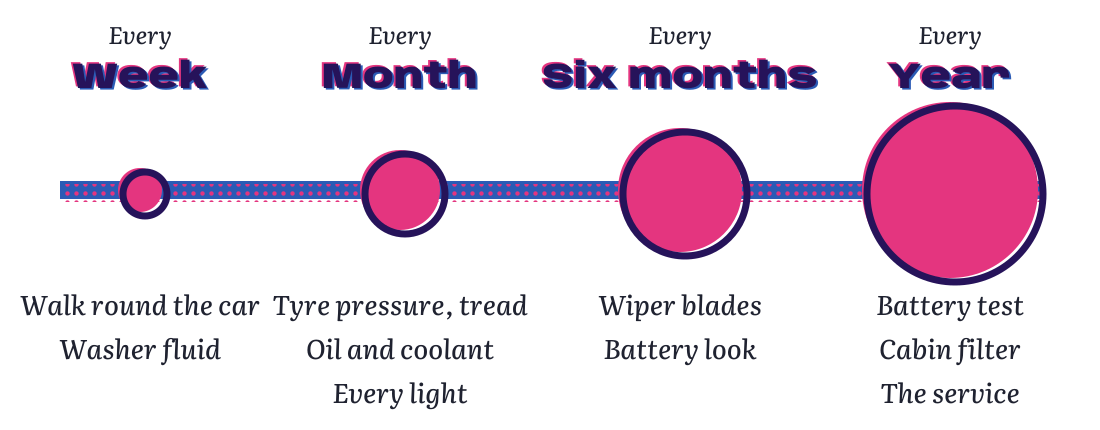
Every week: walk round the car
Once a week, before you drive off, walk round the car and look.
It is a short walk round and needs no tools. You are not measuring anything yet. You are looking for anything that has changed since last time.
- Look at all four tyres. One that sits lower than the others, a bulge or a cut in the side, or a nail in the tread is worth a closer look today.
- Look at the ground where the car was parked. Fresh drops or a small puddle under the engine are worth noting. Clear water dripping after the air conditioning has run is normal.
- Look at the glass, the mirrors and the lights. Wipe them clean if they are dirty, and look for cracks or a lamp that has gone out.
- Check the washer fluid level in its reservoir and top it up with a screen wash made for cars when it is low. Use one made for freezing weather when it is cold, and never put coolant in the washer reservoir.
One maker’s owner’s manual asks for some of these same checks every time you stop for fuel: the coolant and washer fluid levels, and a look for tyres that seem low. If you fill up once a week, the two habits are the same habit.
Every month: tyres, fluids and lights
Once a month, with the engine cold, check the tyre pressures, the tread, the oil, the coolant and every light.
This is the longest check in the routine, and still a short one. Do it at home, in the morning, on level ground, before the car has been driven. “Cold” matters for both tyres and fluids.
Tyre pressure
A tyre maker advises checking the pressure at least once a month, and always with the tyres cold. A tyre counts as cold when the car has stood still for a long time or has been driven no more than a couple of kilometres (about a mile) at low speed, which in practice means before you drive for the day. Driving warms the air inside, so a warm tyre reads high.
- Set each tyre to the pressure on the door-frame label or in the manual. The figure moulded on the tyre’s own sidewall is the most the tyre can hold, not the figure your car needs.
- Some labels give a second, higher pressure for a full load. Use it when the car is full of people and luggage.
- Do not let air out of a warm tyre to reach the figure on the label. When it cools down it will be too soft.
- If your car carries a spare wheel, check it too, a little less often.
Tread depth
The tread is the patterned surface that touches the road, and its grooves clear water away. Tyre makers mould tread wear indicators into the main grooves at about 1.6 mm (2/32 in) of depth. A small arrow or the letters TWI on the sidewall shows where they are. When the tread is level with them, the tyre is worn out and is replaced.

- A tread block, the rubber that touches the road.
- A main groove, which carries water away.
- The tread wear indicator, a raised bar at the bottom of the groove.
- A tread depth gauge: push its pin into the groove until the bar rests on the tread, then read the depth.
Measure in several places across the tyre and around it, because tyres rarely wear evenly. Judge the tyre by the lowest reading. If one edge is much more worn than the other, tell the workshop at the next visit.
Engine oil level
An oil maker recommends checking the oil every couple of weeks, or every 1,600 km (1,000 miles), so a monthly check is the least you want. Your manual says exactly how. Most ask for the car to stand on level ground with the engine off for several minutes, so the oil drains back down.
- Pull the dipstick out and wipe it clean with a cloth.
- Push it all the way back in, then pull it out again.
- Read where the oil film ends on the tip. It should sit between the two marks.
- If it is near the lower mark, add a little of the oil grade named in your manual through the filler cap, wait, and read again. Never fill above the upper mark.

- The lower mark: the least oil the engine should have.
- The upper mark: the most it should have.
- The band between the two marks, where the end of the oil film should be.
- The handle, usually brightly coloured so it is easy to find.
Some cars have no dipstick and show the oil level on the dashboard display instead. The manual explains how to read it.
Coolant level
Coolant is the liquid that carries heat away from the engine. Its reservoir has MIN and MAX marks on the side, and with the engine cold the level should sit between them. The cooling system is under pressure when it is hot, so the cap stays shut until the engine has cooled down. If you find yourself adding coolant often, have the workshop look at the system.
Every light
Switch on the side lights, the headlights, the indicators and the hazard lights in turn, and walk round to see that each one works. For the brake lights, ask someone to watch while you press the pedal, or reverse up to a wall or a window and look in the mirror.
| Check | How | What you want to see |
|---|---|---|
| Tyre pressure | Gauge on each valve, tyres cold | The figure on the door-frame label |
| Tread | Depth gauge in several grooves | Tread well above the wear indicators |
| Oil | Dipstick, level ground, engine off | The oil film ending between the two marks |
| Coolant | Look at the reservoir, engine cold | The level between MIN and MAX |
| Lights | Each switch in turn, with a helper or a reflection | Every lamp lit, none cracked |
Every six months: wipers, battery and hoses
Twice a year, look at the wipers, the battery and the rubber hoses before the weather turns.
Spring and autumn make good reminders, because that is when rain, frost or heat start to test the car.
- Wiper blades. Streaks, smears, juddering or cracked rubber mean the blades are tired. A wiper maker recommends replacing them every six months to a year, or as soon as you notice that you see less clearly through the glass. Between changes, wipe the rubber with a cloth dampened with washer fluid.
- Washer jets. Check that they spray onto the glass, not over the roof.
- The battery. The car’s ordinary 12-volt battery sits under the bonnet, under the boot floor or under a seat; the manual shows where. Look at its terminals: they should be clean and tight, with no white or green crust. Note the date on its label, because its age decides the next step.
- Hoses. Look at the rubber hoses that run to the radiator and the heater. Cracks, swelling or a damp patch are for the workshop to deal with.
Every year: battery test, cabin filter and the service
Once a year, the car goes to the workshop, even if it has barely moved.
Three things come round once a year, and the workshop can do all of them on the same visit.
- A battery test. A battery maker advises having the battery checked at a workshop at least once a year, before winter, and its care guide suggests a test as often as every six months, or before a season of very hot or very cold weather. Short trips are hard on a battery, because over a short distance the alternator (the part that recharges it while the engine runs) cannot fully recharge it. The same maker counts a battery more than three to five years old among the signs that it is time for a new one.
- A new cabin air filter. This filter cleans the air that comes in through the vents. A filter maker recommends changing it at least once a year or every 15,000 km (about 9,300 miles), and says some car makers allow up to 24 months. Windows that fog easily, weaker airflow or a musty smell are signs it is due.
- The service. Engine oil ages even when the car stands still, so an oil maker advises changing it at least once a year, whatever the distance. That alone is a reason for a yearly visit.
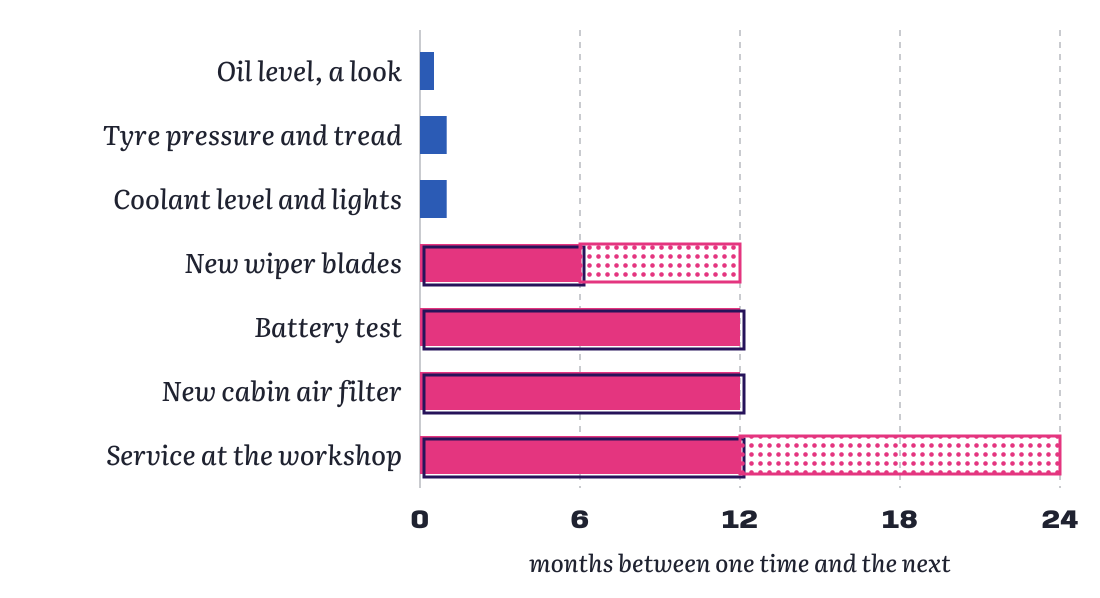
| Item | Typical interval | Source |
|---|---|---|
| Oil level | Every couple of weeks or 1,600 km (1,000 miles) | Oil maker’s advice |
| Tyre pressure | At least once a month, tyres cold | Tyre maker’s advice |
| Coolant level and lights | At least once a month | One maker’s owner’s manual |
| Wiper blades | Replace every 6 to 12 months | Wiper maker’s advice |
| Battery | Checked at least once a year, before winter | Battery maker’s advice |
| Cabin air filter | Once a year or 15,000 km (9,300 miles) | Filter maker’s advice |
| Service | Every 12 to 24 months or a set distance, whichever comes first | Two car makers’ owner’s manuals |
What a regular service takes care of
The service covers the work that needs a lift, the right tools and a trained eye.
How often a car needs a service is set in its owner’s manual, by time and by distance, whichever comes first, and the figures differ from one maker and one market to the next. One car maker’s manual, for example, sets its service steps at every 12 months or 15,000 km (10,000 miles) in some markets, and at every 24 months or 30,000 km (20,000 miles) in others. Another maker’s manual uses steps of 12 months or 13,000 km (8,000 miles). The exact interval for yours is in the manual, the service booklet or on the service display.
Going by those two manuals’ charts, a scheduled service:
- changes the engine oil and the oil filter;
- inspects the brakes (the discs and pads, the brake lines and hoses) and the brake fluid, all of which is work for a qualified mechanic;
- inspects the steering and the suspension joints;
- checks the tyres for pressure and tread wear;
- inspects the cooling system and the exhaust;
- checks the condition of the 12-volt battery and the electrical systems;
- inspects or replaces the cabin air filter, and inspects the air conditioning.
In these charts, “inspect” means inspect and, if necessary, adjust, correct, clean or replace.
Some parts have longer intervals of their own, set by the maker in years and in tens of thousands of kilometres. In one maker’s chart, for example, the engine air filter is replaced at every third service and the brake fluid every four years. The service schedule lists each one, so the workshop knows when they fall due.
Some manuals also print a second, shorter schedule for harder use, such as mostly short trips, stop-and-go traffic, very cold weather, dusty roads or towing. Read both and pick the one that sounds like your driving.
| Part | You | The workshop |
|---|---|---|
| Tyres | Pressure and tread every month | Fitting, balancing and wheel alignment |
| Oil | Read the level, top up | Change the oil and filter |
| Coolant | Read the level with the engine cold | Renew it on the maker’s schedule |
| Lights and wipers | Test the lamps, look at the blades | Aim the headlights |
| Battery | Look at the terminals, note its age | Test it and fit a new one |
| Brakes | Tell them about any change you notice | All inspection and work |
Electric and hybrid cars follow the same routine for tyres, wipers, washer fluid, lights, the cabin filter and the 12-volt battery. Their high-voltage parts are for trained technicians only, and their manuals have a service schedule of their own.
Between checks, notice what changes
If the car sounds, feels or smells different, write it down and tell the workshop.
The routine has a quiet partner: paying attention while you drive. The owner’s manual that asks for checks at every fuel stop also lists what to notice, and most of it needs no tools at all.
- A new noise from the exhaust, or an exhaust smell inside the car.
- The steering wheel shaking, feeling heavier, or no longer centred when you drive straight.
- The car drifting to one side on a flat, smooth road.
- A new sound, a pull to one side or a different pedal feel when you slow down.
- Fluid under the car where it usually parks.
Note when it happens, at what speed and whether the engine was cold or warm. That short note helps the workshop find the cause quickly. If a light comes on in the instrument panel, your manual explains what it means and what to do next.
Keep a one-page record
Write down the date, the distance and what was done, every time.
A record turns the routine into a habit. One page in the glovebox, or a note on your phone, is enough. Write the date and the distance on the odometer for each check, and keep the workshop’s service notes with it.
| Date | Distance | What was done | Next |
|---|---|---|---|
| 2 March | 41,200 km | Monthly check, front tyres topped up | Early April |
| 6 April | 42,050 km | Monthly check, new wiper blades | Early May |
| 11 May | 43,300 km | Service: oil, oil filter, cabin filter, battery test | Next May or 58,300 km |
With the record in one place, the next date is never a guess, and the workshop can see at a glance what has already been done.
Common questions
Short answers to questions drivers often have about the routine.
My car has no dipstick. How do I check the oil?
Many newer cars measure the oil electronically and show the level on the dashboard display, usually through a menu on the steering wheel or the screen. The manual explains where to find it and how long the engine has to stand first.
I hardly drive. Do I still need the yearly service?
Yes. Oil ages even when the car stands still, tyres slowly lose air and a battery that is rarely charged by a long drive runs down. A car that is driven little still needs its yearly visit, and its monthly checks.
My car warns me when a tyre is low. Do I still need the gauge?
Keep the monthly check. A warning tells you that a pressure has already dropped a long way, while the gauge shows you the exact figure and lets you set every tyre to the label.
Can I do the service myself?
This poster stops at the checks you can do from the outside with the engine off. Work under a raised car, anything on the brakes and anything on the high-voltage parts of an electric or hybrid car is work for a qualified mechanic.
Sources
Every figure on this poster comes from a source you can open and check.
Each source was read on 13 November 2026. Figures change, so the date matters.
- Michelin, How to check your tyre pressure: checking at least once a month and with cold tyres, what counts as a cold tyre, where the recommended pressure is printed, and not letting air out of warm tyres.
- Michelin, Tyre pressure advice: the label in the door frame and the manual as sources of the right pressure, and checking the spare wheel.
- Continental, Tread depth: tread wear indicators, the TWI mark, 1.6 mm, and measuring in several places.
- Castrol, How often to check engine oil: checking every couple of weeks or 1,000 miles.
- Castrol, How many miles between oil changes: the manual first, changing oil at least once a year, and harder driving.
- Kia, Owner maintenance schedule, an example of an owner’s manual: checks at fuel stops, monthly, every six months and yearly, and what to notice while driving.
- Kia, Engine coolant, from another edition of the same maker’s manual: the coolant level between MIN and MAX with the engine cool, and the cap kept shut when hot.
- Rain-X, Wiper blade information and maintenance: replacing blades every six months to a year, or sooner when visibility drops.
- VARTA, Avoid battery failure: a workshop battery check at least once a year before winter, and why short trips are hard on a battery.
- Clarios, Car battery maintenance guide, from the same battery maker: testing every six months or before seasons of extreme weather, and an age of more than three to five years as a sign to replace a battery.
- Hyundai, Normal maintenance schedule (except Europe) and Normal maintenance schedule (for Europe), a second example of an owner’s manual: service steps of 12 months or 15,000 km and of 24 months or 30,000 km, whichever comes first, and the items each service inspects or replaces.
- Kia, Normal maintenance schedule, from the manual cited above: service steps of 12 months or 13,000 km, the oil and oil filter changed at each one, the battery’s condition inspected, the longer intervals of the engine air filter and the brake fluid, and the shorter schedule for harder use.
- MAHLE, Fresh filter, fresh air: changing the cabin filter once a year or every 15,000 km, and the signs of a clogged one.
How Right Posters writes and checks its posters is set out in the editorial policy.
Right Posters Words & Pictures
Editorial team
Right Posters Words & Pictures is the editorial team that writes and draws every poster on Right Posters. We work from car makers’ manuals and the reference sources each poster lists, give typical ranges rather than one number for every car, and correct or update a poster as soon as we find something wrong or out of date.